I had the wonderful opportunity to visit with Peter Leung, a businessman and civic leader based in Eugene, Oregon. Mr. Leung had the distinction of becoming the first Chinese-American to serve as the president of a local chapter (Corvallis) of the National Association for the Advancement of Colored People (NAACP). He currently serves as vice president of the Eugene chapter of the NAACP, and remains committed to lending a voice for peoples of color. Previously, he was appointed as the chair of the Oregon Commission on Asian Affairs. In his role, he developed close working relationships with both the local Latino and African-American communities. I'm happy to learn about his work and vision for moving the NAACP chapter forward.
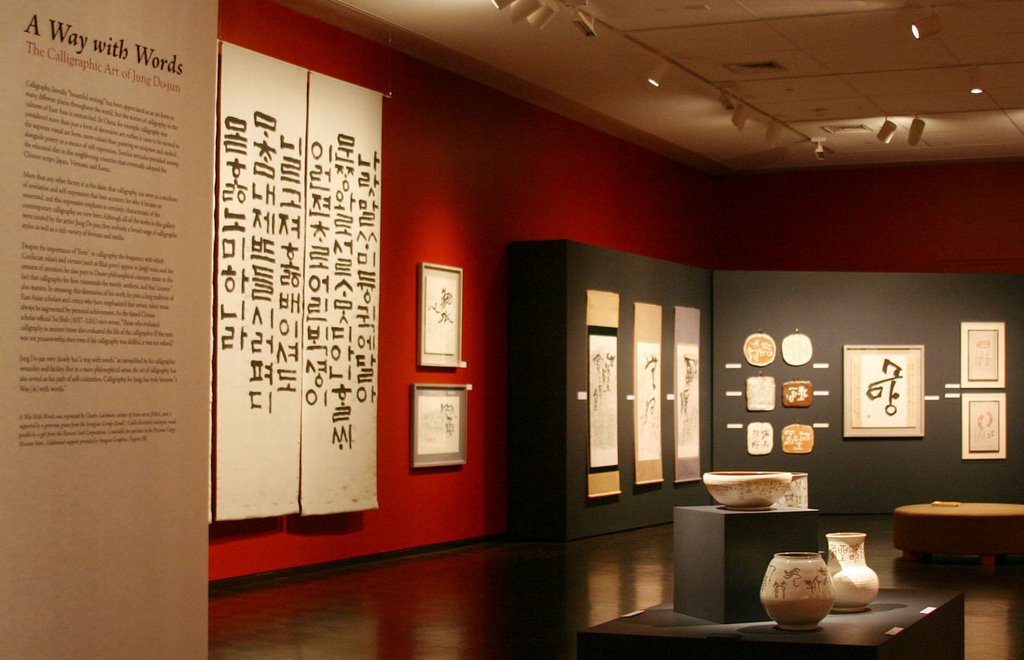
While in Eugene, I also took the opportunity to view the University of Oregon Jordan Schnitzer Museum of Fine Art exhibit A Way With Words: The Calligraphic Art of Jung Do-jun. In Korea and other parts of Asia, calligraphy was traditionally regarded among the highest of the visual arts. This is the first exhibition of Jung Do-jun's work in the United States. The artist has exhibited widely in Korea, and has had the honor of being selected to execute large memorial tablets and inscriptions at several imperial palaces in Seoul.
I'm impressed to learn that the Jordan Schnitzer Museum of Fine Art is steadily increasing its collection of Asian art, featuring Korean, Chinese and Japanese art and artifacts. According to John Vollmer, textile scholar and former curator at the Royal Ontario Museum, the museum houses "one of the most significant public collections of Chinese costumes in North America." Its Japanese holdings include woodblock prints, early Imari and Kutani ware ceramics, and lacquer ware. The museum's growing collection of Korean art features traditional costumes and accessories, ceramics, paintings, and bronzes.

While in Eugene, I also took the opportunity to view the University of Oregon Jordan Schnitzer Museum of Fine Art exhibit A Way With Words: The Calligraphic Art of Jung Do-jun. In Korea and other parts of Asia, calligraphy was traditionally regarded among the highest of the visual arts. This is the first exhibition of Jung Do-jun's work in the United States. The artist has exhibited widely in Korea, and has had the honor of being selected to execute large memorial tablets and inscriptions at several imperial palaces in Seoul.
I'm impressed to learn that the Jordan Schnitzer Museum of Fine Art is steadily increasing its collection of Asian art, featuring Korean, Chinese and Japanese art and artifacts. According to John Vollmer, textile scholar and former curator at the Royal Ontario Museum, the museum houses "one of the most significant public collections of Chinese costumes in North America." Its Japanese holdings include woodblock prints, early Imari and Kutani ware ceramics, and lacquer ware. The museum's growing collection of Korean art features traditional costumes and accessories, ceramics, paintings, and bronzes.