Book Review: Sickening - Anti-Black Racism and Health Disparities

Buy from UMN Press


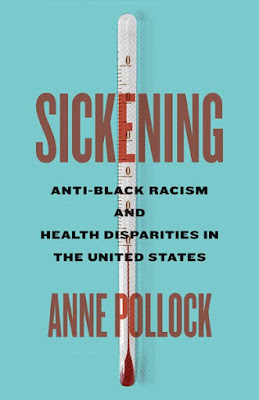
Racism is embedded in systems, structure and institutions in the United States. Nowhere else is its effects more profound and prolific than in systems of public health, healthcare and environmental justice. In Sickening: Anti-Black Racism and Health Disparities, Professor Anne Pollock illustrates through case studies the pervasive and precarious intersection of racism against Black Americans with social determinants of health.

Anne Pollock

The book is an important teaching tool for students of various disciplines to take a critical view of individual stories that have implications for social justice. Pollock focuses of 21st century issues that impact the lives of Black Americans, through the lenses of the war on terror, mass incarceration, unnatural disaster, environmental racism and reproductive justice. Black mail workers were exposed to anthrax shortly after the 9/11 tragedy. Hurricane Katrina claimed the lives of almost 2,000 people and displaced thousands of majority Black residents. The children of Flint, Michigan were subjected to drinking lead-contaminated water for years, without proper resolution. Tennis superstar Serena Williams discussed her difficulty getting the help she needed after the birth of her child. 


Each case offers ample evidence of differential and inequitable treatment of Black Americans, highlighting that the scourge of racism is not in the distant past, but continues to afflict Black communities in the present day. Pollock, a professor of social medicine and global health, raises the question of citizenship and “racialized biopolitics,” shining light on whose lives are valued and whose lives are disregarded.

Pollock offers an analytical tool to examine how racist systems cause persistent health disparities. The analysis template allows one to identify a particular example of social injustice, and invites the reader to apply the frames of institutionalized, personally mediated and internalized racism. She also challenges the reader to expand their analytical frame by delving deeper into historical, economic, intersectional and other contexts.

Pollock began writing the book before the COVID-19 pandemic exposed the vulnerabilities of Black communities during a global pandemic. She discusses the twin crises of the pandemic and social uprising that erupted from the tragic and senseless murders of George Floyd, Breonna Taylor and Ahmaud Arbery at the hands of police and right-wing vigilantes. Pollock’s examination of the depth of interlinking social injustices that harm Black communities is much needed during this time, as we continue to grapple with the continuing public health crisis. This book offers us the tools to think and act critically about workable solutions, as we recognize injustice and realize our part in dismantling systems of inequities.

Popular posts from this blog

Lucky Tomorrow: Stories

Deborah Jiang-Stein's debut collection of short stories explores the lives of people who are often overlooked. From flower street vendors to families torn apart by ambition, to a woman on death row awaiting redemption amidst a tumult of memories, Jiang-Stein vividly depicts their struggles. Each story is set in various cities where she has lived: Seattle, Minneapolis, and Tokyo. While these settings differ, they share a common indifference toward human suffering. In "Lucky Tomorrow, " each vignette offers a glimpse into harsh realities that are often difficult to confront, yet are grounded in the lived experiences of those frequently unseen and cast aside. The stories convey powerful themes of longing and fleeting hopes for fresh starts that may never arrive. Although the themes are specific to the characters, they resonate with the universal human experience. As an activist and advocate, Jiang-Stein has made a significant impact through her extensive work with women...

Medicine Wheel for the Planet

Jennifer Grenz, PhD       Working toward ecological healing requires awareness of how Indigenous ancestral knowledge and living ways can complement Western scientific approaches to environmental restoration and protection practices. Dr. Jennifer Grenz (Nlaxa’pamux mixed ancestry) worked for more than two decades as a field researcher and practitioner for environmental nonprofit organizations, where she worked with different levels of government, including First Nations in Canada. "Medicine Wheel for the Planet" compiles Grenz’s most potent realizations about the lack of forward movement in addressing an impending ecological catastrophe.  A warming climate impacts not only human lives but also the natural balance that relies on reciprocal relationships rooted in deep connections to the land. She uses the metaphor of the four directions of the Indigenous “medicine wheel” to invite openness to Indigenous teachings, letting go of colonial narratives, merging lessons f...

Memento - Embracing the Darkness

Dennis "Dizzy" Doan Stories about overcoming and persevering through family dysfunction, poverty, and mental health challenges offer hope and the promise of better days. Dennis “Dizzy” Doan’s memoir Memento: Embracing the Darkness is one such story, with the added complexity of being raised in an immigrant Vietnamese family. Doan’s parents dealt with the mental and emotional aftermath of war, which forcibly uprooted them from their homeland. In the United States, they struggled to create a safe and stable life for their two sons. Doan shares his journey of finding himself, his craft, and eventually a successful tattoo business in Southern California despite personal strife and run-ins with the law. Doan is best known for developing the aesthetic language to combat anti-Asian hate that erupted during the COVID-19 pandemic. His art series titled “Model Minority” went viral, sparking conversation about Asian American identities and harmful stereotypes. In Memento, Doan showcase...