
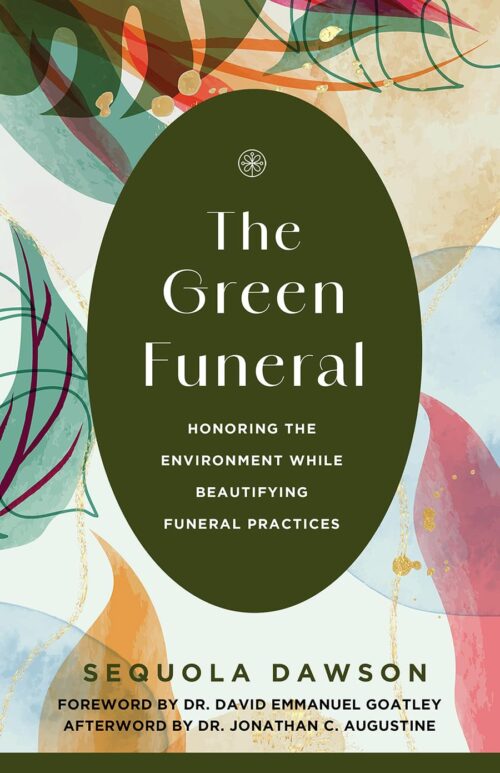
The Green Funeral


The Rev. Dr. Sequola Dawson delivers a bold and necessary intervention in her critique of Black Church funeral practices. Identifying as an “earth theologian” and “bereavement minister,” Dawson advocates for environmentally conscious “green funerals” that honor both God’s covenant with the faithful and our collective responsibility to steward the land. Her arguments are firmly anchored in ecclesial training, environmental research, intimate knowledge of the Black community, and practical experience with parishioners. (Pictured above is the author)

I am a non-Black person of color interested in nature-based burial practices. I approach The Green Funeral: Honoring the Environment While Beautifying Funeral Practices with awareness of my social location and the limitations of my perspective on Black traditions and experiences. What makes it particularly compelling is Dawson’s unvarnished perspective on the Black Church. She doesn’t shy away from challenging long-held beliefs and attitudes about dying, death, and the ecological crisis—a courage rooted in her deep love for and commitment to her community. Her writing skillfully blends academic rigor with the persuasive, prophetic call to action characteristic of faith leaders.

Dawson’s focus on environmental theology opens crucial conversations about how communities of faith can respond to the climate crisis through reimagined death practices. For readers interested in nature-based burials, this book provides theological grounding and cultural context often missing from mainstream green death discourse. It’s essential reading for anyone seeking to integrate ecological justice with spiritual practice and community tradition.

Editor's Note: This review was originally published in San Francisco Book Review.
Buy from Capital Books

Popular posts from this blog

Minding the Wealth Gap

As a Black investor and startup founder, Cliff Goins IV brings firsthand experience and sharp insight to one of America’s most urgent issues: the racial wealth gap. Having navigated the worlds of finance and entrepreneurship, Goins has seen up close the systemic disparities in wealth creation, access to capital, and asset management. From unequal opportunities in homeownership and education to persistent challenges in business funding and employment, the historical gaps are perpetuated in present-day practices. In "Minding the Wealth Gap," Goins skillfully blends data, lived experience, and the insights of experts to illuminate the deep-rooted economic disparities facing Black Americans. More importantly, he highlights the power of collective uplift. Through the voices of nine dynamic “gap closers,” Goins shows how real change happens when Black investors and leaders open doors for others. Each success “play” or strategy underscores the ripple effect of support. Selena Cu...

Slow Down: The Degrowth Manifesto

In "Slow Down: The Degrowth Manifesto," renowned Marxian scholar and philosopher Kohei Saito offers a compelling argument against the relentless pursuit of economic growth that permeates contemporary capitalism. Saito’s thesis focuses on the concept of degrowth—a radical reduction in production and consumption that aligns with sustainable ecological limits rather than constant expansion. Pictured above is Kohei Saito Saito makes a significant and timely contribution to the ongoing conversation about sustainable living. Slow Down adopts an interdisciplinary approach, drawing insights from environmental science, economics, and social theory to present a clear and urgent depiction of the current ecological crisis. Saito critiques the widely accepted belief that economic growth equates to progress and questions the sustainability of existing global consumption patterns. He advocates for a fundamental reshaping of our economic systems to prioritize human well-being and ecologica...

A Beginner’s Guide to the Roots of Yoga

The modern practice of yoga in Western culture is often criticized for disconnecting from its cultural, historical, and spiritual roots. In many studios and gyms, yoga is reduced to a fitness routine—focused on stretching rather than its original purpose of enlightening the mind. In "A Beginner’s Guide to the Roots of Yoga," celebrated practitioner Nikita Desai reconnects readers with yoga’s ancient Indian origins. Drawing on her Indian heritage, Desai explores the deeper meanings behind yoga’s forms, postures, and intentions, offering a rich historical and philosophical context for those seeking a more authentic practice. Desai shares her personal journey of reclaiming yoga’s essence, inviting readers to do the same by integrating cultural awareness into their practice. Her tone is welcoming and nonjudgmental, making the book accessible to readers of all backgrounds. Although I do not practice yoga, my meditation roots lie in Zen Buddhism. Through conversations with prac...