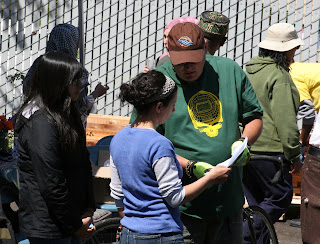
My daughter Carmilla and I had the opportunity to take part in Groundwork Portland's River Rally service project to build the "Seeds of Understanding" community garden in North Portland. The new community garden will serve Portland's growing Somali-American community.
The new urban garden will help enhance urban food sites and improve stormwater management serving low-income and minority residents in North and Northeast Portland.

 Volunteers helped remove invasive weeds, complete an outdoor learning center/cob bench, install rain barrels, plant fruit trees and berry vines, construct an eco-roof kiosk, and build raised garden beds at two locations: the MCC-owned Seeds of Understanding urban farm and Groundwork Portland facilitated Emerson Street Garden, located at 822 NE Emerson Street.

 The volunteer events focused on community-supported initiatives that reduce health and environmental disparities for immigrants and refugee populations, low-income and minority communities, and people experiencing homelessness in the Portland metro area. This service project was held in partnership with local residents to enhance sites that will serve their communities for the long-term.
The U.S. Environmental Protection Agency’s Urban Waters program is the sponsor of the service project events. Other supporters for the project day include TERRA.fluxus LLC, Environs, Portland Bureau of Environmental Services, Portland Office of Healthy Working Rivers, Right 2 Dream, and Somali Youth of Oregon.
The volunteer events focused on community-supported initiatives that reduce health and environmental disparities for immigrants and refugee populations, low-income and minority communities, and people experiencing homelessness in the Portland metro area. This service project was held in partnership with local residents to enhance sites that will serve their communities for the long-term.
The U.S. Environmental Protection Agency’s Urban Waters program is the sponsor of the service project events. Other supporters for the project day include TERRA.fluxus LLC, Environs, Portland Bureau of Environmental Services, Portland Office of Healthy Working Rivers, Right 2 Dream, and Somali Youth of Oregon.