
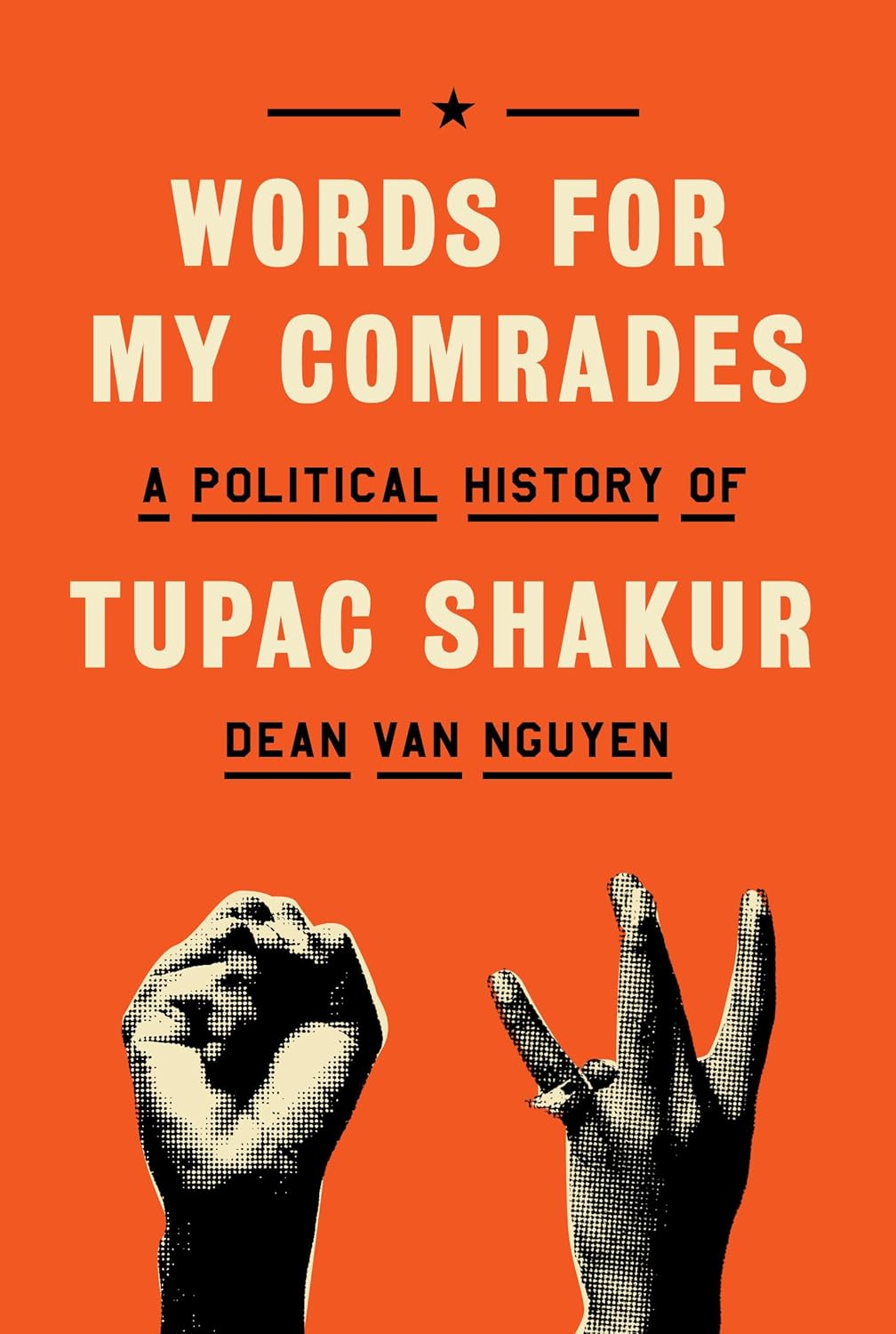
Words for My Comrades: A Political History of Tupac Shakur

In "Words for My Comrades: A Political History of Tupac Shakur," Dean Van Nguyen expertly weaves a compelling narrative of Tupac Shakur’s legacy on global resistance and liberation struggles. Anchored in his mother Afeni Shakur’s activism in the Black Panthers movement, 2Pac’s body of work represents defiance and opposition to classist and racist power.

I read this book as a Gen Xer, a non-Black immigrant woman of color who found meaning in both hip hop and grunge rock cultures of my youth. The cultural history of hiphop through 2Pac’s persona and music presented opportunities for nostalgia and grief about our generation’s collective loss when 2Pac was gunned down, a loss of a powerful voice that spoke to our struggles and aspirations. To build the story arc of a revolutionary hero, Van Nguyen expands the narrative by detailing the young rapper’s awakening into the realities of racial disparities, political marginalization, and economic inequities.

Van Nguyen demonstrates a nuanced approach to telling 2Pac’s story, as he discusses the constellation of collaborators and influencers that impacted the artist’s creative process and personal challenges. He dissects the rapper’s “incorruptible” iconic legacy due to his infectious, confrontational energy and the profound emotional depth and vulnerability of his verses. Amid the pull of capitalist and business necessities, 2Pac was able to stay above it all to create music that named the people’s fears and rage, and with confidence and swagger, encouraged us to stand by our convictions.

Editor's Note: This review was orginally published in Los Angeles Book Review.
Buy from Capital Books

Popular posts from this blog

Slow Down: The Degrowth Manifesto

In "Slow Down: The Degrowth Manifesto," renowned Marxian scholar and philosopher Kohei Saito offers a compelling argument against the relentless pursuit of economic growth that permeates contemporary capitalism. Saito’s thesis focuses on the concept of degrowth—a radical reduction in production and consumption that aligns with sustainable ecological limits rather than constant expansion. Pictured above is Kohei Saito Saito makes a significant and timely contribution to the ongoing conversation about sustainable living. Slow Down adopts an interdisciplinary approach, drawing insights from environmental science, economics, and social theory to present a clear and urgent depiction of the current ecological crisis. Saito critiques the widely accepted belief that economic growth equates to progress and questions the sustainability of existing global consumption patterns. He advocates for a fundamental reshaping of our economic systems to prioritize human well-being and ecologica...

Enlighten Me

Editor's Note: This review was originally published in Los Angeles Book Review . Author Minh Lê Standing up for oneself seems like doing the right thing. Binh did just that in the face of a racist school bully who was poking fun at his Asian heritage. But physically assaulting another student goes against school policy, and it was Binh who got in trouble. Binh shares a silent retreat with his family and younger siblings. Along with other children, he learns about stories from the previous lives of the Buddha. The stories are interesting, but for Binh, it is difficult to sit still and clear his mind when he misses his Gameboy. While he struggles with silence, he learns important lessons about friendship, community, and being present. In the graphic novel "Enlighten Me," award-winning author Minh Lê and bestselling illustrator Chan Chau tell the story of a boy who gains a better understanding of himself as he works on quieting the mind and reflecting on dharma. Lê and Ch...

Minding the Wealth Gap

As a Black investor and startup founder, Cliff Goins IV brings firsthand experience and sharp insight to one of America’s most urgent issues: the racial wealth gap. Having navigated the worlds of finance and entrepreneurship, Goins has seen up close the systemic disparities in wealth creation, access to capital, and asset management. From unequal opportunities in homeownership and education to persistent challenges in business funding and employment, the historical gaps are perpetuated in present-day practices. In "Minding the Wealth Gap," Goins skillfully blends data, lived experience, and the insights of experts to illuminate the deep-rooted economic disparities facing Black Americans. More importantly, he highlights the power of collective uplift. Through the voices of nine dynamic “gap closers,” Goins shows how real change happens when Black investors and leaders open doors for others. Each success “play” or strategy underscores the ripple effect of support. Selena Cu...