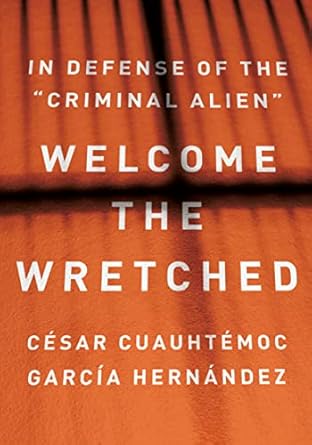
Welcome the Wretched: In Defense of the Criminal Alien

The assault on the civil rights, humanity, and dignity of migrants – particularly those who are low-income people of color – is at a fever pitch. High-profile cases bring to light the egregious overreach of immigration enforcement in undermining the rule of law. As we witness the unfolding terror, it becomes increasingly urgent to understand the roots of the racist criminal justice system. Historian César Cuauhtémoc García Hernández writes a retrospective of how the law was weaponized against immigrants during the first Trump administration, citing criminality and lawlessness as the basis for violating the civil rights of people in the United States.

Through the stories of newcomers like José Inéz García Zárate, 21 Savage, Sandra Castañeda, and others, García Hernández displays the flaws, inconsistencies, outright cruelty, and vindictiveness in the exploitation of policies and enforcement actions. The book offers a powerful critique of the prejudices embedded in defining criminality, the questions of citizenship and rights, and how violent and harmful rhetoric misalign with American values.

“Welcome the Wretched” is a timely piece, even as it reads almost like a time capsule as we face the current assaults against the demonized “criminal alien.” García Hernández offers us a nuanced look at the policing practices of the Department of Homeland Security (DHS) and the role of local police.

García Hernández writes from a historical perspective, explaining case law, the documented incidents of inconsistencies and abject racism, and the sociopolitical climate that fueled immigration raids. I appreciate how he broke down the components of the “immigration industrial complex” that involves corporate actors like Amazon and Palantir, a company run by billionaire kingmaker Peter Thiel. He shows the complicity of the U.S. Congress in enabling taxpayer dollars to fund private companies to profit from the misery and dehumanization of others.

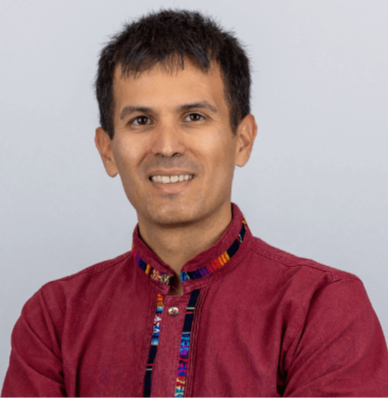
Another strength of the book is how García Hernández integrates his own lived experiences and observations as a Brown immigrant in academia, and the reflexivity required to write courageously about the errant contradictions of shared values and laws. By reconstructing the complicated, contradictory immigration laws tied to criminal law, he advocates for opposing injustice and upholding human rights.
Buy from Bookshop

Editor’s Note: “Welcome the Wrteched” is among the outstanding books recognized in the 2025 Colorado Book Awards, a program of Colorado Humanities. I am proud to serve as a volunteer selector and judge for the Colorado Book Awards.

Popular posts from this blog

Minding the Wealth Gap

As a Black investor and startup founder, Cliff Goins IV brings firsthand experience and sharp insight to one of America’s most urgent issues: the racial wealth gap. Having navigated the worlds of finance and entrepreneurship, Goins has seen up close the systemic disparities in wealth creation, access to capital, and asset management. From unequal opportunities in homeownership and education to persistent challenges in business funding and employment, the historical gaps are perpetuated in present-day practices. In "Minding the Wealth Gap," Goins skillfully blends data, lived experience, and the insights of experts to illuminate the deep-rooted economic disparities facing Black Americans. More importantly, he highlights the power of collective uplift. Through the voices of nine dynamic “gap closers,” Goins shows how real change happens when Black investors and leaders open doors for others. Each success “play” or strategy underscores the ripple effect of support. Selena Cu...

Slow Down: The Degrowth Manifesto

In "Slow Down: The Degrowth Manifesto," renowned Marxian scholar and philosopher Kohei Saito offers a compelling argument against the relentless pursuit of economic growth that permeates contemporary capitalism. Saito’s thesis focuses on the concept of degrowth—a radical reduction in production and consumption that aligns with sustainable ecological limits rather than constant expansion. Pictured above is Kohei Saito Saito makes a significant and timely contribution to the ongoing conversation about sustainable living. Slow Down adopts an interdisciplinary approach, drawing insights from environmental science, economics, and social theory to present a clear and urgent depiction of the current ecological crisis. Saito critiques the widely accepted belief that economic growth equates to progress and questions the sustainability of existing global consumption patterns. He advocates for a fundamental reshaping of our economic systems to prioritize human well-being and ecologica...

Wash

Ebony Stewart’s "Wash" is a powerful, unflinching poetry collection that draws the reader into a world of raw emotion, deep introspection, and lyrical brilliance. As I read through the poems, I found myself captivated by Stewart’s honest reflections on identity, love, loss, and healing. Her voice is unapologetically bold, revealing the complexities of being a Black womxn navigating relationships, societal expectations, and hard-fought victories toward self-worth. Yet, her themes are universal, resonating with anyone who has grappled with their own identity and relationships. What struck me most was Stewart’s emotional transparency: each poem feels like a cleansing, a shedding of shame, doubt, and grief, revealing the triumph of knowing one’s value in a world that often seeks to diminish it. Stewart doesn’t shy away from exploring the pain of extractive love or the vulnerability of desire, but she also leaves room for empowerment and resilience. As a celebrated spoken word ...